
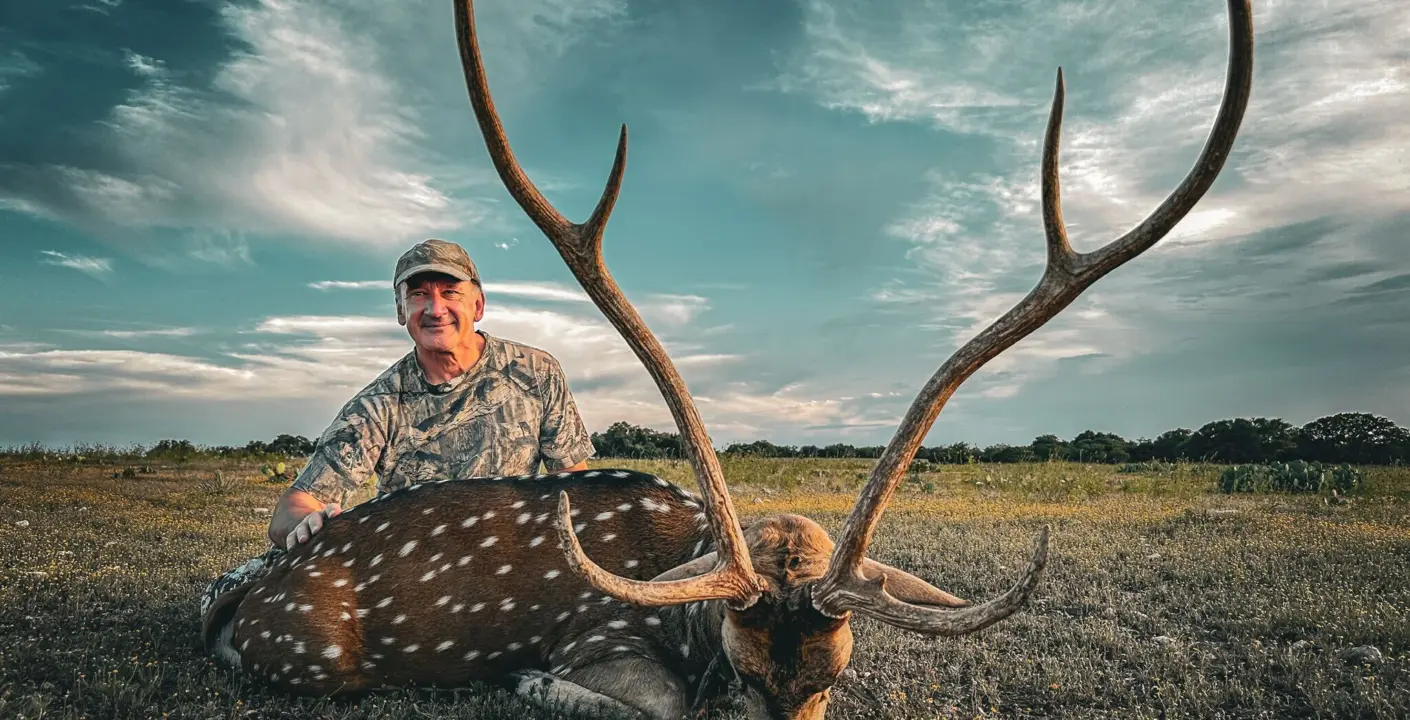
The short version: axis deer can be hunted in Texas every day of the year, because they are exotics and have no closed season. The best window for a mature, hard-antlered, actively rutting buck is roughly mid-May through August, peaking in June and July. But axis do not run a synchronized rut, so hard-antlered bucks in rutting condition can be found in any month - which is why this is the only trophy animal in North America you can genuinely hunt in February and August with equal legitimacy.
I guide axis out of Kerrville, in Kerr County, which is about as close to the center of the axis world as Texas gets.
Why the Hill Country is the place
Axis deer were introduced to Texas around 1932. They took to the Edwards Plateau better than they had any right to, and today there are more than 15,000 free-living axis in the state, concentrated in central and south Texas and very common throughout the Hill Country. Kerr County and Kimble County are among the strongholds. Axis are now the most abundant exotic ungulate in Texas.
The reason is terrain and climate. The limestone canyons, cedar breaks and live oak country of the Hill Country are a reasonable stand-in for the dry deciduous forest of the Indian subcontinent, and the mild winters mean the herds never take the hit that would keep them in check further north.
For a hunter, that density is the whole point. You are not hunting a novelty population that somebody stocked last spring. You are hunting a species that has been reproducing here for almost a century.
The antler cycle - this is the part that trips people up
Whitetail hunters arrive with a mental model that does not apply.
Whitetail are photoperiod-driven: antlers harden, the rut happens, antlers drop, all more or less in unison across a region. You plan around a calendar.
Axis are not synchronized. Individual bucks run their own independent cycles. At any point in the year, some portion of the bucks on a property are in hard antler and in rutting condition, some are in velvet, and some have just dropped. That is not a defect - it is how the species works in its native range, where there is no hard winter to force a schedule.
The practical consequences:
- There is no month in which axis hunting is impossible.
- There is no month in which every buck is a good buck.
- Glassing and patience matter more than calendar timing.
- A guide who knows which animals on which property are currently in hard antler is worth more than a perfect date.
The peak: mid-May through August
That said, there is a real peak. The major breeding season runs mid-May through August with June and July the most active months. Roughly 80% of Texas axis fawns are born from early January to mid-April, which is the arithmetic confirming it.
What the peak actually buys you:
Bucks are audible. Rutting axis bark and bugle - a strange, high, carrying sound, nothing like an elk and nothing like a whitetail grunt. In June and July you can locate animals by ear at first light, which changes the whole nature of the hunt.
Bucks are careless. A mature axis buck is a genuinely wary animal with an excellent nose. During peak rut he is following does and paying less attention than he should. That is the window.
Bucks are gathered. Rutting activity concentrates animals, which means more mature bucks glassed per morning and a real ability to pass on the first one you see.
Coats and antlers are at their best. The photographs from a July hunt look different from the photographs from a January hunt.
The trade-off is honest: it is hot. Hill Country summer means starting well before light, being done by mid-morning, sitting out the middle of the day and going back out in the evening. Field care becomes urgent rather than casual - capes do not keep in July heat, and this is one of the places where an outfitter’s skinning-shed discipline stops being an abstraction.
The off-peak case, which is stronger than most people expect
Hunting axis from September through April gets less attention and it should not.
You will find fewer rutting bucks, but you will still find hard-antlered mature animals, because of the unsynchronized cycle. What you gain:
- Weather. Hill Country fall and winter are excellent to hunt in - cool mornings, comfortable middays, no urgency about the meat or the cape.
- Pressure. The summer axis rush is real. Fall is quieter country.
- Stacking species. Aoudad, fallow, oryx, red stag and mouflon all hunt better in cool weather. If you want more than one animal on one trip, fall and winter make a much better itinerary than July does. Our Hill Country species list has the full range.
- Whitetail overlap. The Texas general whitetail season runs roughly November into early January. That is the only window in which you can take an axis and a Texas whitetail on the same trip.
My honest advice: if you want the axis experience - the barking, the rut, the summer canyon country - come in June or July. If you want a good axis buck and a comfortable hunt and possibly a second species, come in the fall.
How we actually hunt them
Spot and stalk. Glass the canyon rims, the draw heads and the edges of the oak motts in the first hour of light. Locate, then close.
Axis have a very good nose and better nerves than whitetail. They spook differently too - a whitetail blows and bounds; an axis tends to melt and reappear two hundred yards away in cover you did not know was there. The last hundred yards is where axis hunts are won and lost, and it is the part that surprises experienced whitetail hunters most.
Shots are typically 100 to 250 yards, though it depends entirely on the country you end up in. A .270, .308, 7mm or .30-06 class rifle is more than adequate. If you would rather not fly with a rifle, we can provide one.
Either Turner or I am with you in the field. Not a subcontractor.
What it costs
- Daily rate: $350 per hunter per night, $250 per non-hunting guest per night. Lodging, meals and guiding included.
- Axis trophy fee: $6,000, charged only on an animal taken.
So a three-night hunt with a buck on the ground is $1,050 plus $6,000. Full price list is on the pricing page, and the arithmetic on a full trip is in What a Texas Exotic Hunt Costs in 2026.
A word on prices. These numbers are current as of 2026 and they do move. Animal values change, a hard freeze or a drought changes what a ranch can carry, and market conditions do what they do. Treat this as a planning guide rather than a quote - call me at 830-928-5426 and I’ll shoot you straight on what your hunt costs today.
What you need legally
A valid Texas hunting license, and the landowner’s permission - which comes with booking. There is no axis tag, no draw, no bag limit and no closed season, because exotics on private land in Texas carry none of those. The full legal picture is in Exotic Hunting in Texas: How It Actually Works.
Getting here
Kerrville is roughly an hour from San Antonio International (SAT), about two hours from Austin (AUS). Most hunters fly into San Antonio and drive.
Common questions
When is the axis rut in Texas? Mid-May through August, peaking June-July.
Can I hunt axis in winter? Yes. Hard-antlered bucks exist year-round; there is no closed season. You will glass more animals to find one.
Is axis good to eat? It is the best venison in Texas and it is not particularly close. Mild, fine-grained, no gaminess. Hunters who do not normally take meat home take axis home.
How big is a good Hill Country axis buck? A mature buck carries three points per side with long beams. Trophy quality varies by property and by year; we will tell you honestly what a given ranch is producing before you book.
More at the FAQ page.
Booking
If you are trying to decide between a July rut hunt and a November mixed-bag hunt, call and describe what you actually want out of the trip. Ten minutes on the phone is worth more than any article.
Dalton Bannister - 830-928-5426, or reach out here.