
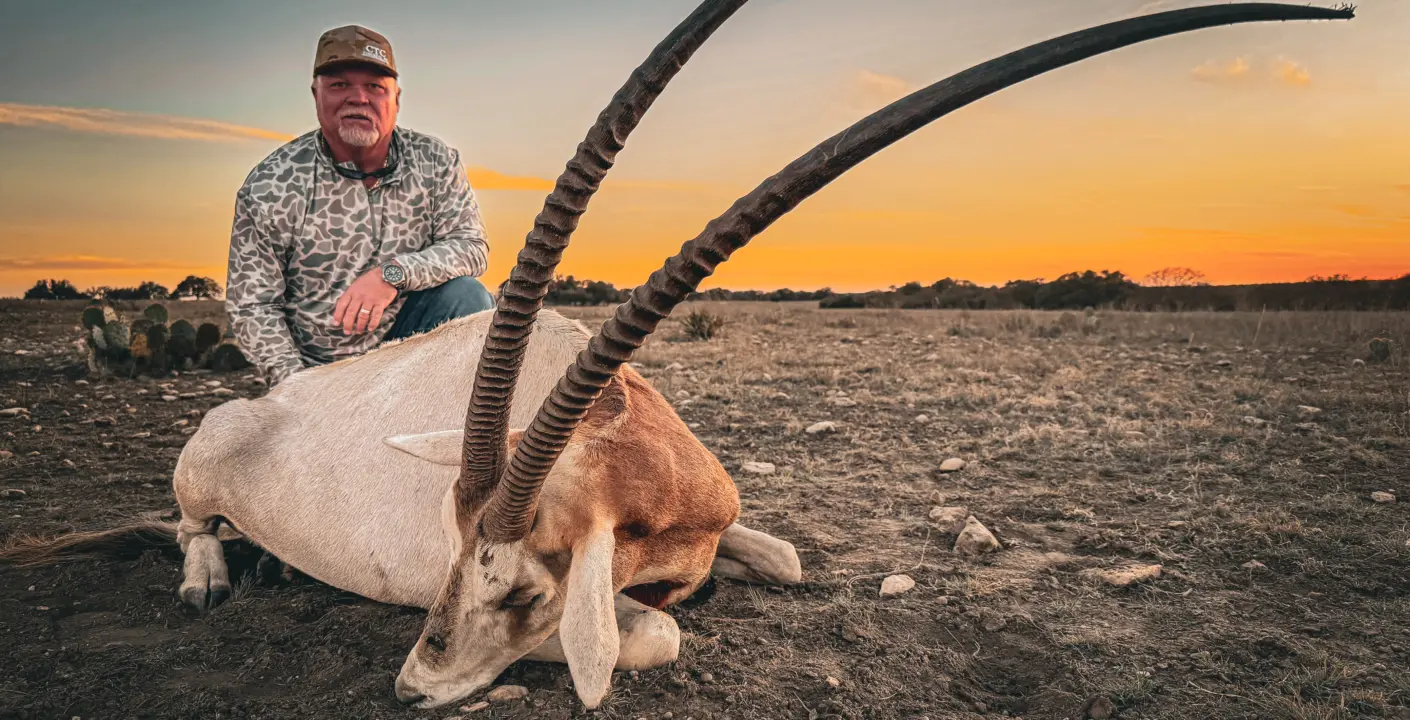
The short version: a Texas exotic hunt is quoted in two parts - a daily rate covering lodging, meals and guiding, and a trophy fee charged per animal taken. Ours are $350 per hunter per night and $250 per non-hunting guest per night, with trophy fees from $5,000 to $50,000 depending on species. A typical three-night axis hunt comes to about $7,050 all in. You pay no trophy fee for an animal you do not take.
Here is the whole thing itemized, including the costs most outfitters leave out of the first conversation.
The two-part structure, and why it exists
Hunters coming from a guided elk or whitetail background often expect one number. Exotic hunting does not work that way, and the reason is straightforward: the animals are privately owned property, and they vary in value by a factor of ten.
The daily rate buys your time on the ranch - a bed, three meals, and a guide in the truck with you. It is charged whether or not you take anything.
The trophy fee buys the animal. It is charged when the animal is taken and recovered, and not otherwise.
Splitting them means a hunter chasing a $5,000 blackbuck and a hunter chasing a $30,000 sable pay the same to be there and different amounts for what they leave with. It is the fairest structure available, and it is the industry standard in Texas for a reason.
Our daily rates
| Per night | |
|---|---|
| Hunter | $350 |
| Non-hunting guest | $250 |
Includes lodging, all meals, and guiding. See the lodging page for what the accommodation actually is.
One note: daily rates do not apply to our West Texas hunts, which are priced differently. Everything below is Hill Country.
Trophy fees, 2026
Common exotics
| Species | Trophy fee |
|---|---|
| Blackbuck | $5,000 |
| Japanese Sika | $5,500 |
| Axis Deer | $6,000 |
| Aoudad | $6,500 |
| Mouflon | $7,500 |
| Red Sheep | $7,500 |
| Fallow Deer | $8,500 |
| Scimitar-Horned Oryx | $8,500 |
| Bison | $10,000 |
| Red Stag | On request |
Super exotics
| Species | Trophy fee |
|---|---|
| Hog Deer | $5,000 |
| Nilgai | $7,500 |
| Springbok | $7,500 |
| Blesbok | $8,500 |
| Pere David Deer | $8,500 |
| Waterbuck | $9,500 |
| Dybowski Sika | $9,500 |
| Addax | $10,000 |
| Arabian Oryx | $10,000 |
| Blue Wildebeest | $10,000 |
| Dama Gazelle | $10,000 |
| Eland | $10,000 |
| Gemsbok | $11,000 |
| Grants Gazelle | $12,500 |
| Nile Lechwe | $15,000 |
| Red Lechwe | $15,000 |
| Trans-Caspian Urial | $15,000 |
| Sitatunga | $20,000 |
| Kudu | $30,000 |
| Roan | $30,000 |
| Sable | $30,000 |
| Bongo | $50,000 |
| Markhor | $650 per inch |
| Nubian Ibex | $600 per inch |
Texas whitetail
| Class | Trophy fee |
|---|---|
| Up to 150 inches | $5,000 |
| 150-200 inches | $9,000 |
| 200-300 inches | $14,500 |
| 300 inches and up | $18,500 |
Whitetail are native, so they run on the Texas general season - roughly November into early January - with tags and bag limits, unlike the exotics above. See the whitetail page.
The live list always governs; it is on our pricing page.
A word on prices. Everything above is current as of 2026 and it does move. Animal values change, a hard freeze or a drought changes what a ranch can carry, and market conditions do what they do. Treat this page as a planning guide rather than a quote - call me at 830-928-5426 and I’ll shoot you straight on what your hunt costs today.
Three worked examples
A first exotic: three nights, one axis buck
| Item | Cost |
|---|---|
| Daily rate, 3 nights | $1,050 |
| Axis trophy fee | $6,000 |
| Total | $7,050 |
Plus a Texas hunting license, travel to San Antonio and taxidermy afterward.
A couple’s trip: four nights, hunter plus non-hunting spouse, one aoudad
| Item | Cost |
|---|---|
| Hunter daily rate, 4 nights | $1,400 |
| Guest daily rate, 4 nights | $1,000 |
| Aoudad trophy fee | $6,500 |
| Total | $8,900 |
A mixed bag: five nights, axis and scimitar-horned oryx
| Item | Cost |
|---|---|
| Daily rate, 5 nights | $1,750 |
| Axis trophy fee | $6,000 |
| Scimitar-horned oryx trophy fee | $8,500 |
| Total | $16,250 |
Fall or winter is the right window for a multi-species trip - see the axis season guide for why.
What is not in the trophy fee
This is the part that separates an honest quote from a cheap one. Budget for:
Texas hunting license. Required for exotics. Non-resident options vary; buy it through Texas Parks and Wildlife before you travel.
Travel. Flights into San Antonio (about an hour out) or Austin (about two hours), and a rental car.
Taxidermy. The single biggest post-hunt cost and the one most often forgotten. A shoulder mount is generally four figures and takes months. Field care, skinning and caping happen in camp at no extra charge, and we coordinate with local taxidermists - but the mount itself is between you and them.
Meat processing. If you want the meat - and with axis you should - processing is separate.
Gratuity. Customary, at your discretion.
Ammunition. Bring your own, or use a rifle we provide.
What is included that you might be paying for elsewhere
- Lodging and all meals, in the daily rate
- Guiding, in the daily rate - no separate guide fee
- Field care, skinning and caping in camp
- Coordination with taxidermists
- Use of a rifle if you would rather not travel with one
Why there is no “package price”
Some operations advertise an all-in package. There is nothing wrong with that, but it means one of two things: either the package assumes you take the animal (and you pay for it if you do not), or the daily portion is inflated to cover the risk.
We would rather you paid $1,050 and went home without an animal than paid $7,050 and went home without an animal. That happens rarely, but it happens, and the pricing should reflect it.
What drives the price differences
The trophy fee gap between a $5,000 blackbuck and a $30,000 sable is not about difficulty. It tracks scarcity and the cost of maintaining a breeding population. Sable, roan, bongo and kudu are expensive to hold in Texas and are held in small numbers. Axis and blackbuck have been reproducing on the Edwards Plateau since 1932 - blackbuck were originally released right here in Kerr County - and there are tens of thousands of them.
Practically: the common exotics are the better value and, for most hunters, the better hunt. A rutting axis buck in June is as good as this sport gets, at $6,000.
If you are picking a first species, this guide is the one to read.
Deposits and booking
Call and we will quote the specific species and dates in writing before anything is due. If you would like to hunt something not on the list, ask - the list is long but not exhaustive.
Dalton Bannister - 830-928-5426, or use the contact form. More answers on the FAQ page.
A word on prices. These numbers are current as of 2026 and they do move. Animal values change, a hard freeze or a drought changes what a ranch can carry, and market conditions do what they do. Treat this as a planning guide rather than a quote - call me at 830-928-5426 and I’ll shoot you straight on what your hunt costs today.