
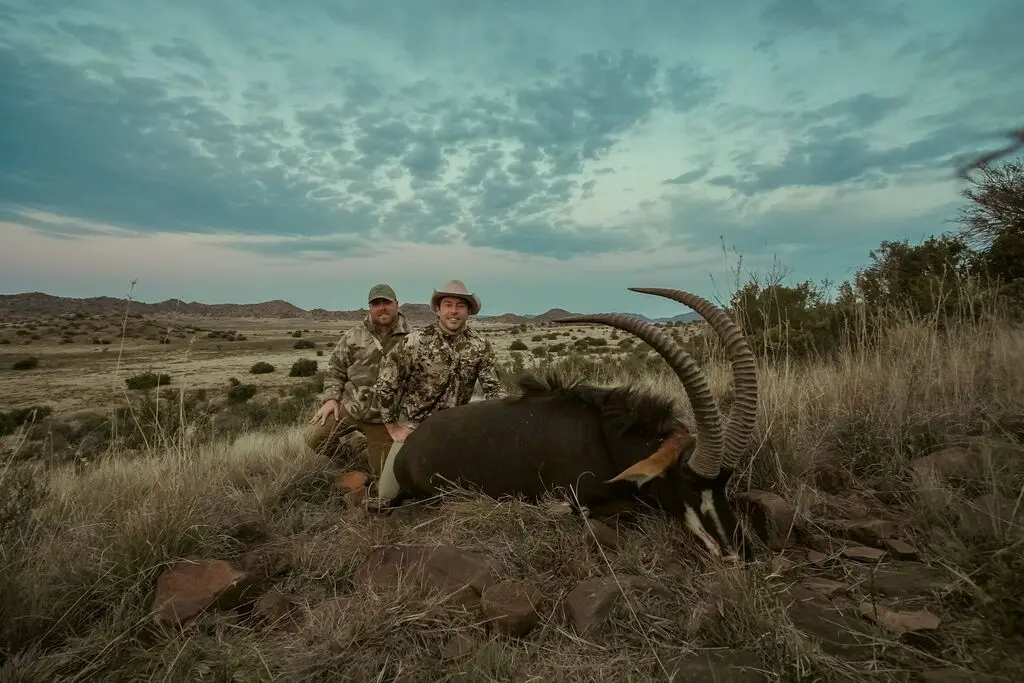
The short version: a plains game safari is quoted as a daily rate per hunter per day, plus a trophy fee for each animal taken, from the low hundreds for impala up to the low thousands for kudu and eland. The honest total depends on your species list, your dates and how many are travelling - which is exactly why we price South Africa per itinerary rather than off a fixed list, the way our published Texas pricing works. Call 830-928-5426 and we will put a real number on your trip.
Here is the whole thing itemised, including the costs that never appear in a first conversation.
The two-part structure
Same as Texas exotic hunting, and the split confuses first-timers more than anything else.
The daily rate buys your time in camp: accommodation, all meals, your professional hunter, trackers, skinners, field preparation, permits and airport transfers. It is charged per day whether or not you take anything.
The trophy fee buys the animal. Charged when it is taken and recovered, and not otherwise.
Splitting them means a hunter chasing impala and a hunter chasing sable pay the same to be there and different amounts for what they leave with. It is the fairest structure available and it is the industry standard for good reason.
Daily rates
The daily rate depends on how you hunt: a 1×1 (one hunter, one PH) runs highest per person, a 2×1 (two hunters sharing a PH) costs each hunter less, and a non-hunting observer costs less again. We do not publish South Africa’s daily rate here for the same reason we do not publish trophy fees - the number that matters is the one built for your actual trip. See our published pricing for how we quote, or call 830-928-5426 for South Africa numbers.
2×1 is not a lesser hunt. Two friends or a father and son sharing a PH is how a great many safaris are run, and it saves real money. What it costs you is flexibility - you hunt the same ground on the same schedule.
Trophy fees, by rough band
Every species carries its own trophy fee on top of the daily rate. Entry-level plains game like impala, blesbok, warthog and springbok sit at the low end; mid-tier animals like blue wildebeest, zebra and red hartebeest cost more; kudu, eland and upper-tier species like gemsbok and waterbuck cost more again; and specialist species like sable and roan, along with dangerous game like Cape buffalo, sit in their own category entirely.
We do not publish South Africa numbers, because a bands list invites comparison to a quote that is not real. We price South Africa per itinerary, because the honest number depends on your species list, your dates, which properties we use and how many are travelling. Call 830-928-5426 and we will put a real figure in writing.
Our Texas pricing, by contrast, is published in full on the pricing page - because Texas exotics are a fixed list and Africa genuinely is not.
What a real itinerary looks like
Every itinerary is different, but the pattern is always the same: your daily rate for the length of your stay and party size, plus a trophy fee for each animal you take. A first safari with a short species list looks very different on paper from a ten-day hunt taking six animals, or a couple travelling together with an observer - which is exactly why we do not publish worked totals here. Call 830-928-5426 with your species list and dates, and we will build the real number with you.
What is not in those numbers
This is where budgets go wrong. Add:
International flights. Figure $3,000-$10,000 return from Texas depending on season and how far ahead you book. Most routes run through Johannesburg. We recommend booking through PWP Travel, who know hunter travel and airline firearm clearance inside and out.
Domestic connection to Port Elizabeth, usually a few hundred dollars.
Dip and pack. Treating and crating your trophies to meet import requirements. Commonly $500-$1,200 depending on how many animals and whether you are shipping skulls or full skins.
Freight and customs clearance to the US. Another $800-$2,000 for a typical plains game crate, and it varies a lot with volume and port.
Taxidermy at home. The single largest post-hunt cost and the one most often forgotten. A shoulder mount is four figures, and six animals is a serious bill spread over the following year. We recommend Woodbury Taxidermy for the mount work.
Tips. Customary, and kept simple: tips are generally given in US dollars to the lodge owner, who distributes them across the staff so everyone - PH, trackers, skinners, camp staff - gets their fair share. We do not recommend tipping individual workers different amounts; singling people out that way causes real friction on camp and can cause harm. Hand it to the lodge owner and let them do right by their team.
Rifle permit. Free - the SAPS 520 costs nothing. But if you use a meet-and-greet service at Johannesburg to walk your paperwork through, that is a modest fee and the best money spent on the whole trip.
Travel insurance and a medical evacuation policy. Cheap, and you will not think about it again.
So what does it actually come to?
For a ten-day trip taking five or six plains game animals, flights included and trophies delivered to your taxidermist, the real number depends on your species list, your dates and how many are travelling. See our published pricing for how we quote, then call 830-928-5426 and we will build your actual number.
That number is worth getting before you book, not after, because the two failure modes are equally common: hunters who assume Africa is out of reach and never ask, and hunters who budget only the safari invoice and get surprised by the shipping.
Where the cheap quotes come from
If a quote comes in far under the market, one of a few things is happening:
- The daily rate is low and the trophy fees are inflated, so the bill arrives on the back end
- Extras appear on site - sundries, transfers, fuel surcharges, trophy handling
- The animals are not on the property and you spend your days looking
- The camp is genuinely rough in a way the photographs do not show
None of that makes a cheap operator dishonest. It does mean the comparison is not like for like, and the only way to know is to get everything in writing first. How to vet an outfitter covers what to ask.
How to bring the cost down honestly
Hunt 2×1. Bring a friend. It is the single biggest saving available and it costs you very little.
Shoulder seasons. The South Africa season runs roughly April through September, and July is peak - school holidays back home plus the coolest, driest weeks in-country, so camps and PHs book up fastest. May and September are the shoulder months just before and after that peak: the weather and hunting are still excellent, but camps have more open dates, so it is easier to build the itinerary you actually want.
Be realistic about the list. Six good animals beats ten rushed ones, and it costs less.
Skip the rifle. Borrowing one removes the permit, the airline fees and the handling. We provide rifles on request.
Decide on taxidermy before you go. European mounts and skulls cost a fraction of shoulder mounts and ship far cheaper. Nobody makes you decide in camp, but knowing in advance changes what you take.
A word on prices. Everything above is current as of 2026 and it does move. Animal values shift, fuel and freight change, and exchange rates do what they do. Treat this as a planning guide rather than a quote - call me at 830-928-5426 and I’ll shoot you straight on what your trip actually costs today.
Next
How many days you actually need is the other half of this decision, and the complete first safari plan covers everything else.
When you want a real number for real dates, call Dalton at 830-928-5426 or send us your list.